


 Zoosystema
48 (8) - Pages 211-271
Zoosystema
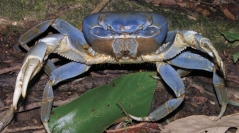
48 (8) - Pages 211-271To date, there is no real consensus on the taxonomic status of the family Gecarcinidae H. Milne Edwards, 1837 (land crabs or terrestrial crabs), which is generally considered to comprise seven genera (without including Epigrapsus Heller, 1862) and is currently subordinate to the superfamily Grapsoidea MacLeay, 1838. The congruence between adult morphology and larval data allows us to elevate Gecarcinidae to a higher rank and, by providing a diagnosis, to formally establish the Gecarcinoidea H. Milne Edwards, 1837 n. stat. Contrary to the current view, morphology alone, with its unique characters, argues in favour of a superfamily Gecarcinoidea very distinct from the Grapsoidea. Furthermore, the adult morphology and larval data highlight the heterogeneity of Gecarcinoidea n. stat. and, in addition, the existence of separately evolving lineages within it, as documented by Guinot et al. (2018). Recent genetic studies have confirmed the diversity of the group, so that, despite unambiguous morphological and biological similarities supporting the Gecarcinoidea n. stat., this group can be divided into two groups of genera sharing a set of characters that allows the relevant criteria for their delimitation to be explicitly recognised. These two groups therefore deserve formal nomina, as follows: Gecarcinidae restrict. to encompass the genera Gecarcinus Leach, 1814, Gecarcoidea H. Milne Edwards, 1837, Hartnollius Guinot, Rodríguez Moreno & Toledano-Carrasco, 2025, and Johngarthia Türkay, 1970; and Cardisomatidae n. fam. to encompass the genera Cardisoma Latreille in Le Peletier, Serville & Guérin, 1828, Discoplax A. Milne Edwards, 1867 and Tuerkayana Guinot, N. K. Ng & Rodríguez Moreno, 2018. The case of the genus Discoplax, whose three species all live in caves, often in water, and which are included in the family of terrestrial crabs Gecarcinidae sensu lato despite significant morphological differences, is discussed. Cardisomatidae n. fam. forms a group of land crabs that are less terrestrial than Gecarcinidae restrict., and this difference in the degree of terrestriality is reflected in morphological characters that allow them to be differentiated. The morphological study of a series of new characters, practically never used in carcinological taxonomy, namely the female pleon and telson, as well as the female pleopods, provides a new informative dataset for the family-level discrimination of Gecarcinoidea n. stat. The Gecarcinoidea n. stat. becomes a crown group of Thoracotremata Guinot, 1977. Based on morphological, biological, larval, and genetic data, Epigrapsus Heller, 1862, generally considered a Gecarcinidae sensu lato, though often in an isolated position, and containing only two species, is here split into two genera, namely Epigrapsus restrict. and Grapsodes Heller, 1865 (which we are reviving), each with a new diagnosis. These two genera share no characters that could link them to either the Cardisomatidae n. fam. or the Gecarcinidae restrict.: rather different from each other, each could represent a distinct family within the Grapsoidea sensu lato, unless they can be incorporated into other existing families of shore crabs or others groups.
land crabs, cave crabs, Grapsodes, Thoracotremata, Grapsoidea, male gonopore, female pleon, adaptations, new family, new status