


 Geodiversitas
48 (5) - Pages 69-85
Geodiversitas
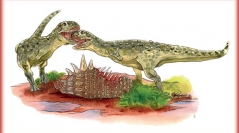
48 (5) - Pages 69-85Bite marks in the fossil record provide information on trophic, behavioural and taphonomic interactions. Here we describe a bevelled bite mark with parallel striations on a denticulate tooth tentatively assigned to Abelisauridae indet. from the Upper Cretaceous (Campanian-Maastrichtian) deposit of Massecaps (municipality of Cruzy, Hérault), in southern France. Comparison of the bite mark with the different morphologies of serrated teeth found on the same deposit enables us to attribute it to the tooth morphotype that we tentatively refer to Abelisauridae indet. Although rarely described in the literature, similar confamilial bite marks have already been observed on Tyrannosauridae Osborn, 1906 teeth. The position and orientation of the bite mark rule out the possibility that it was made by one individual on another, during agonistic behaviour such as head-biting. The relatively large number (n = 44) of rootless teeth attributed to Abelisauridae indet. found at Massecaps locality, the scarcity of other Abelisauridae Bonaparte & Novas, 1985 skeletal remains, and the presence of non-theropod dinosaur skeletal remains marked by serrated teeth strongly suggest that these teeth were lost during the consumption of a carcasses and that tooth M5246 was marked on that occasion. The description of this previously undocumented mark among Abelisauridae expands our knowledge of large theropods feeding behaviour from the Campanian-Maastrichtian period.
Mesozoic, paleoecology, theropod, taphonomy, feeding behaviour