

 Comptes Rendus Palevol
25 (5) - Pages 77-98
Comptes Rendus Palevol
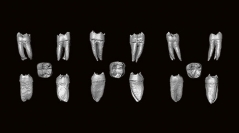
25 (5) - Pages 77-98This study investigates the enamel-dentine junction (EDJ) morphology of the first and second mandibular molars (LM1 and LM2) in late Middle Stone Age (MSA) hominins from northwestern Africa, associated with Aterian technocomplexes. These Aterian specimens are compared with fossil Homo sapiens from Jebel Irhoud, Qafzeh, Skhul, and Die Kelders, as well as with large samples of H. neanderthalensis and recent H. sapiens. By focusing exclusively on the EDJ, this study aims to clarify the evolutionary relationships between Aterians and other hominin groups during the Late Pleistocene. Using micro-computed tomography (micro-CT), we analyzed the EDJ in three dimensions, enabling detailed geometric morphometric comparisons. The results reveal a clear trend of molar size reduction within the H. sapiens lineage, as well as a morphological distinction between H. neanderthalensis and all forms of H. sapiens. Aterians are distinct from all other groups due to the larger size of their dentition. Morphologically, the EDJ of the Aterian sample aligns more closely with the sample of fossil H. sapiens than with the sample of H. neanderthalensis, particularly in LM1s. LM2s display greater variability, with some specimens, such as El Harhoura LRM2 overlapping the range of variation observed in H. neanderthalensis. However, this overlap likely reflects the retention of primitive traits within Aterians, due partially to their geological age and partially to their larger size. Our findings contribute to broader discussions on the morphological diversity and evolutionary pathways of fossil H. sapiens. The mosaic of dental traits observed in Aterian hominins is discussed in context of regional variations in the evolutionary trajectories of Late Pleistocene hominin populations.
Aterian, Homo sapiens, MSA, mandibular molars, LM1, LM2, MicroCT, EDJ, geometric, morphometrics