

 Comptes Rendus Palevol
24 (29) - Pages 587-620
Comptes Rendus Palevol
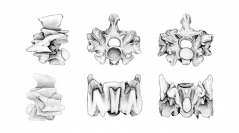
24 (29) - Pages 587-620We provide a thorough documentation of the vertebral morphology and intracolumnar variation of the enigmatic snake Cadurceryx Hoffstetter & Rage, 1972, from the Eocene of France. Based on abundant vertebrae, pertaining to practically all portions of the column, originating from the middle Eocene (MP 16) of Lavergne in the Phosphorites du Quercy, we conduct a revision of the taxon, provide an emended diagnosis, and highlight a number of distinctive vertebral features that differentiate it from all other snakes. Most prominently, Cadurceryx is characterized by the presence of additional apophyses throughout the trunk, cloacal, and caudal vertebrae, which form (at least partly) true articular joints linking neighbouring vertebrae (additional intervertebral articulations). These additional apophyses are: pterapophyses (present in all vertebrae), extensions of zygapophyses and neural spine, as well as extensions of pleurapophyses (present in caudal vertebrae). We further present additional trunk and/or caudal vertebrae from several other localities in the area of the Phosphorites du Quercy: the middle Eocene (MP 16) of Malpérié, the late Eocene (MP 17) of La Bouffie and Rosières 2, the late Eocene (MP 18) of Sainte Néboule, and from imprecise localities from the “old Quercy collections”. We further conduct a critical evaluation of the original description of the taxon. Based on all these, we conclude that a single species of Cadurceryx was present in France during the middle and late Eocene, i.e., the type species Cadurceryx filholi Hoffstetter & Rage, 1972. A second species of the genus, Cadurceryx pearchi Holman, Harrison & Ward, 2006, known exclusively from caudal vertebrae from the late Eocene (MP 17) of Hordle Cliff, England, is herein also assessed; based on a critical approach of the original publication that established the English species, coupled with the presentation of some new caudal vertebrae from its type locality, we consider that Cadurceryx pearchi represents a nomen dubium, with the material potentially pertaining to ?Cadurceryx sp. or some indeterminate erycid or charinaid snake. We provide a thorough overview of the geographic and stratigraphic distribution of Cadurceryx. Through a detailed comparison with extinct and extant snakes, we discard affinities of Cadurceryx with erycids or charinaids, taking also into consideration that this grouping, according to molecular data, is not monophyletic and that the evolution of complex caudal vertebral morphologies in erycids and charinaids is likely homoplastic. Accordingly, the shared distinctive features of Cadurceryx with erycids and charinaids (presence of additional apophyses in caudal vertebrae that form true articular joints linking neighbouring vertebrae) are herein also regarded as homoplastic. Instead, we show that Cadurceryx possesses a vertebral synapomorphy of tropidophiids, namely the prominent blade-like hypapophysis on trunk vertebrae, that in posterior trunk vertebrae possesses a distinct, straight anteroventral corner, plus additional shared vertebral features. Accordingly, we herein tentatively envisage Cadurceryx as a tropidophiid with convergently evolved apophyseal morphologies with erycids and charinaids. Finally, we attempt a speculative interpretation of the functional morphology of the complex structures of the vertebrae of Cadurceryx, tentatively suggesting that these true articular joints linking neighbouring vertebrae may have offered increased rigidity across the vertebral column and may have acted as an antipredator mechanism.
Serpentes, vertebrae, skeletal description, Paleogene