


 European Journal of Taxonomy
1041 (1) - Pages 1-59
European Journal of Taxonomy
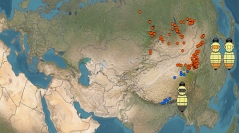
1041 (1) - Pages 1-59Bumblebees of the subgenus Sibiricobombus Vogt, 1911 of the genus Bombus Latreille, 1802 are associated with dry grasslands in the montane regions of Mongolia, Central Asia, the Qinghai-Tibetan Plateau and surrounding mountains, to as far west as Greece. Many of the taxa in this group were described initially from their colour patterns and have at different times been regarded as separate species or have been put into different combinations that were variously regarded as species. We examine integrated evidence for species as evolutionarily independent lineages, comparing evidence from species’ gene coalescents, based on fast-evolving barcode-like DNA sequences, and from discontinuous variation in skeletal morphology and in colour patterns. Many sequences of Sibiricobombus taxa appear from their AT bias at the third codon position to be recent low-divergence numts. Higher frequencies of these numts may be associated with more substitutions within the barcode-primer-binding regions of the mitogenome since the divergence of bumblebees from the lepidopteran source of the primers. Nonetheless, in this particular case, all but one of the 12 species’ gene coalescents support candidate species that are corroborated by morphological diagnoses. For the 11 corroborated species, the status of three species is revised and one new replacement name is proposed: Bombus sibiricus (Fabricius, 1781), B. semenovi Morawitz, 1887 stat. rev., B. oberti Morawitz, 1883, B. morawitzi Radoszkowski, 1876, B. sulfureus Friese, 1905, B. niveatus Kriechbaumer, 1870, B. obtusus Richards, 1951, B. tescorum Williams nom. nov. et stat. rev., B. longiceps Smith, 1878 stat. rev., B. falsificus Richards, 1930 stat. rev., and B. asiaticus Morawitz, 1875. Nine new synonyms are recognised. Estimates are provided for (1) an evolutionary tree for species and (2) for the ancestral species’ distributions.