


 European Journal of Taxonomy
1022 (1) - Pages 1-18
European Journal of Taxonomy
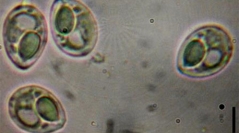
1022 (1) - Pages 1-18A new species of the genus Myxobolus Bütschli, 1882 (Myxosporea: Bivalvulida) is described based on morphology, histopathology, and small subunit ribosomal DNA (SSU rDNA) sequence data. Myxobolus wondjii sp. nov. was found infecting the gills of Labeo batesii Boulenger, 1911 from the Makombè River at Nkondjock, Cameroon. Large, subspherical, whitish plasmodia measuring 100–2000 µm in length and 60–1400 µm in width were observed. Histopathological examination revealed plasmodia located in the interbranchial septum of the gill. Mature myxospores were ovoid, slightly tapering anteriorly, and with a broad, rounded posterior end. The myxospores measured 12.4 ± 0.1 (12.0–13.2) μm in length and 8.8 ± 0.07 (8.3–9.4) μm in width. The two polar capsules were ovoid and distinctly unequal in size, measuring 5.4 ± 0.50 (4.8–6.3) × 3.2 ± 0.06 (2.7–3.7) μm for the larger capsule and 1.6 ± 0.06 (1.4–1.7) × 1.0 ± 0.08 (0.9–1.1) μm for the smaller one. A partial SSU rDNA sequence was obtained from this new species, and phylogenetic analysis placed it as sister to Myxobolus nkondjockei, which also infects L. batesii in Cameroon.